
Morehouse Parole Versus Probation
Parole and probation both allow a person to live in the community under rules, but they begin in different ways. Parole is conditional release from a prison term before full-term discharge. The Louisiana Committee on Parole decides whether parole is granted in eligible cases, while the Louisiana Department of Public Safety and Corrections Division of Probation and Parole supervises the person after release. Probation is imposed by the Fourth Judicial District Court as part of a sentence. A person may receive probation instead of incarceration, after a short jail term, or as part of a split sentence.
The controlling record matters. A parole docket can prove that a hearing was set or that a panel ruled. It does not by itself prove the person left custody. Court minutes can prove that probation was ordered, but the assigned district confirms active supervision. A full discharge means the legal supervision term has ended. It is different from release from a cell while a sentence balance remains.
| Point | Parole | Probation |
|---|---|---|
| How it begins | Conditional release from an eligible prison sentence | Sentence or order entered by the court |
| Decision source | Louisiana Committee on Parole | Fourth Judicial District Court |
| Local supervision | Monroe Probation and Parole District | Monroe Probation and Parole District when DPS&C administers the case |
| Best proof | Board result, release event, and district status | Probation order, docket minutes, and district status |
| How it ends | Revocation, completion, or formal discharge | Revocation, completion, or court discharge |
- Parole
- Conditional community release before the prison term reaches full discharge.
- Probation
- Court-ordered community supervision imposed as part of a criminal sentence.
- Discharge
- The formal end of custody or supervision, not just release from a building.
- Absconder
- A person alleged to have stopped reporting or left supervision without permission.
Check Morehouse Post-Release Supervision
Start with identity, not a status guess. Full name, date of birth, DPS&C number, and a Morehouse court docket number can separate people with similar names. The DPS&C inmate information route covers state prison and community supervision data. Its automated locator can return a custody location, assigned Probation and Parole district, or a projected release date when available. For a parish-jail release with no state sentence, court minutes and the Morehouse Parish Sheriff’s Office release record may be the more useful starting points.
- Identify whether the person left a parish jail, a DPS&C sentence, or a transitional-work placement. The legal custodian controls the next record.
- Use the person’s exact name and DPS&C number in the Louisiana custody and supervision system. Compare date of birth and agency before accepting a match.
- Record the status wording and assigned district. “Community supervision” is not the same as full discharge.
- Call the assigned district to verify active supervision within the information it may lawfully disclose. Morehouse Parish is served by the Monroe District.
- For probation, obtain the Fourth Judicial District Court minutes or probation order from the Morehouse Clerk. For parole, check the official Board docket and result.
- If the question is whether custody actually ended, request the release or discharge date from MPSO or DPS&C instead of relying only on the supervision result.
A released Morehouse Parish person may remain under parole, probation, or good-time supervision. Another person may have completed the full sentence and have no active supervision. The status needs an official label and date. The broader Morehouse Parish released inmate search explains how to pair the custody event with local release and court records.
Note: An assigned district identifies the office handling supervision; it does not by itself establish the date physical custody ended.
Morehouse Supervision Runs Through Monroe
Morehouse Parish has no separate Bastrop probation and parole district listed by DPS&C. The official Monroe District page expressly serves Morehouse residents and even gives driving directions beginning in Bastrop. That local fact prevents a common error: the court file remains with the Morehouse Clerk in Bastrop, while the state supervision office is in Monroe. Call the district about an assigned officer, reporting instructions, or active status. Ask the Clerk about the probation order or court disposition.
The official Monroe District screenshot shows the Morehouse-serving office details. It confirms the office to use after the state locator assigns this district.
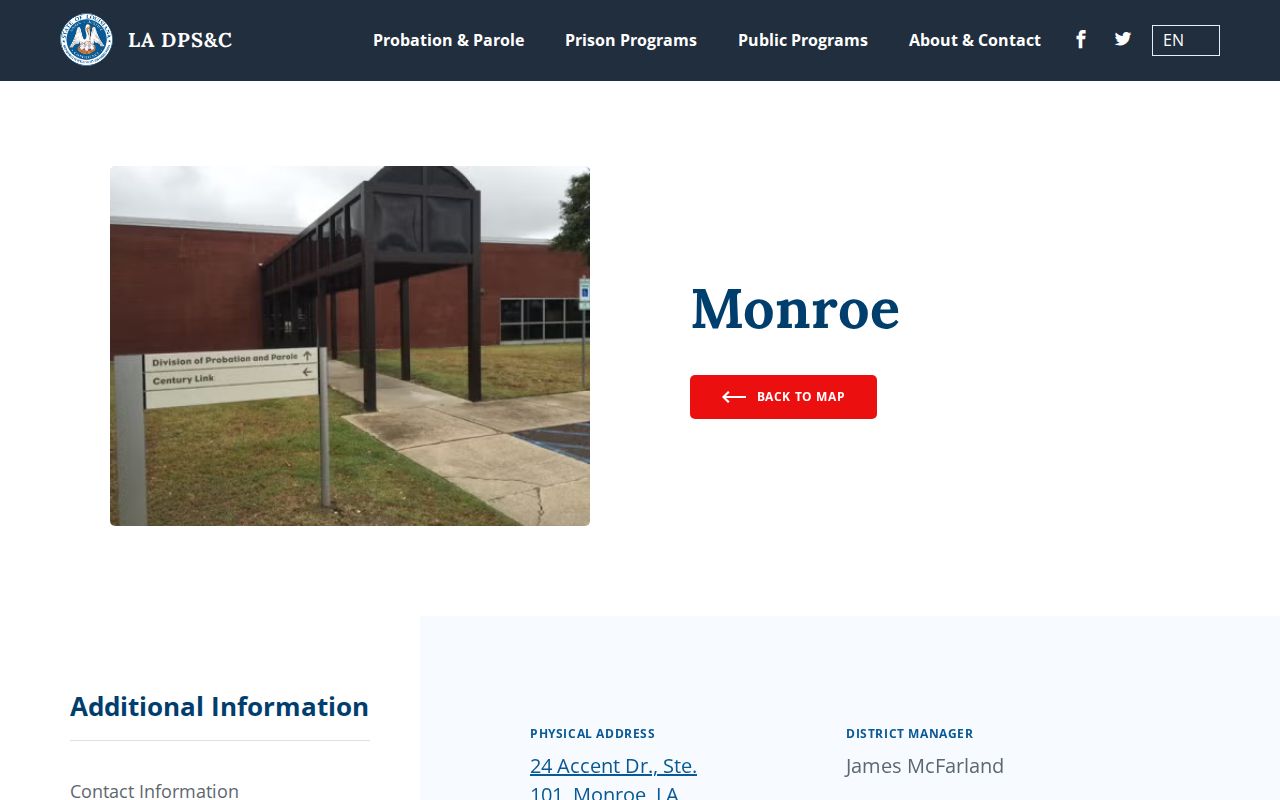
The address and telephone shown there match the state directory and provide a direct channel for supervision questions.
Monroe Probation and Parole District24 Accent Drive, Suite 101
Monroe, LA
318-362-3171
Monday through Friday, 8:00 a.m. to 4:30 p.m.
Morehouse Supervision Status Changes
Supervision can include reporting, residence, travel, treatment, payment, and conduct rules set by the court, parole authority, and supervising agency. The exact conditions belong to the individual order. A violation allegation does not automatically prove revocation. The officer may respond within agency policy, the court may hold a probation hearing, or parole authorities may consider a warrant and revocation process. The legal record should identify what occurred.
Louisiana does not provide a reliable public Morehouse Parish absconder list in the research set. Do not infer absconder or warrant status from a missing VINELink record. Contact the Monroe District or the issuing court. If a warrant is alleged, the issuing agency or court record is the source. VINELink can report custody or supervision changes for participating records, but its alerts have an accuracy and timeliness limitation under R.S. 15:1229.
Morehouse Parole Dockets and Results
The Louisiana parole-dockets hub posts weekly hearing notices and agendas. Those PDFs can identify the panel, applicant, DPS&C number, hearing location, judicial district, start time, and meeting details. The hub also links dockets and results from prior years. Search by the exact DPS&C number when possible, because a matching name alone is weak proof.
The successful capture from the official parole-dockets hub shows the current notices and the route to results.
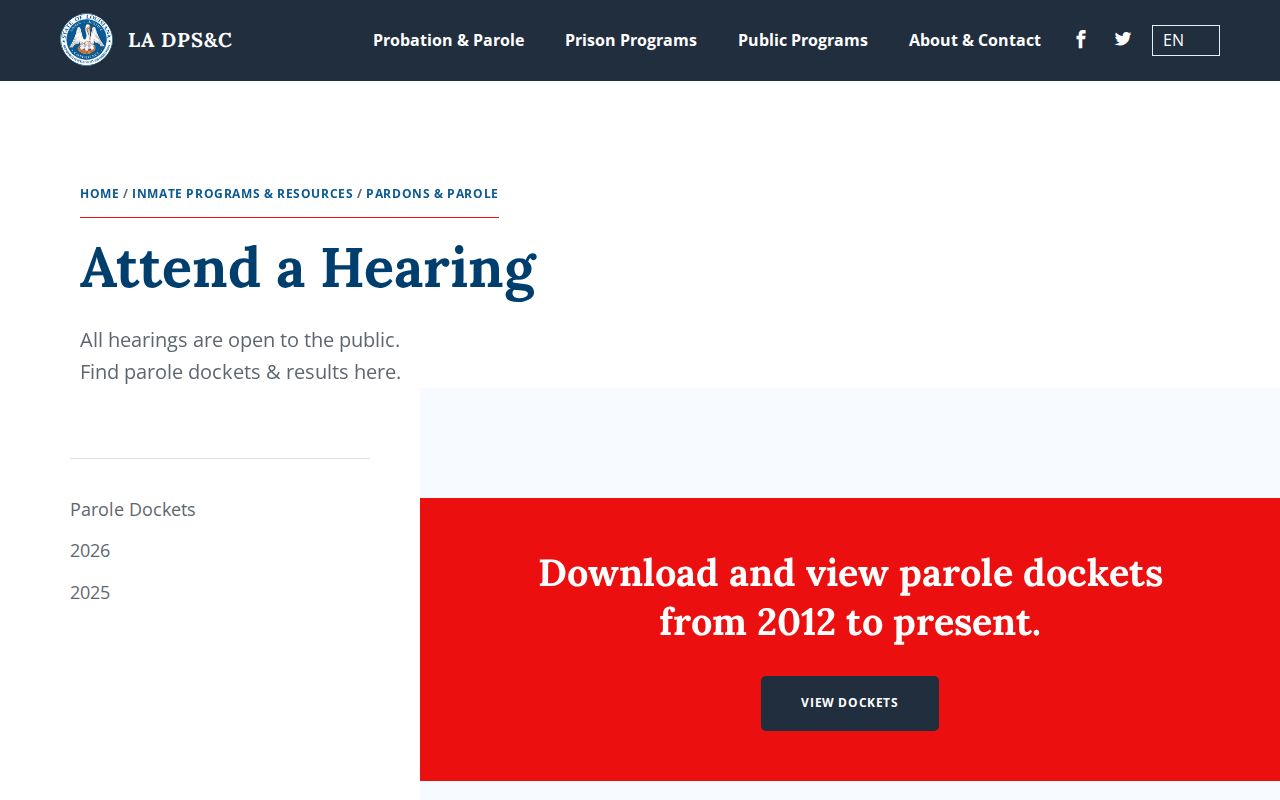
The agenda is a calendar, not a release certificate. A case marked continued, removed, or withdrawn has no merits grant. Even “granted” or “order release” can precede plan approval, detainer resolution, paperwork, and physical departure.
When the linked legacy results system does not open in a modern browser, use the durable hub or contact the Board. Do not fill the gap with an assumed decision. Under Board Policy 03-301, DPS&C calculates eligibility from the offense class and time served. Policy 07-701 keeps guidelines advisory and preserves panel discretion. R.S. 15:574.4 has several cohorts and exclusions, so no single percentage works for all Morehouse Parish cases.
Morehouse Parole Grant Versus Release
A parole grant starts a conditional release process. It is not necessarily the day the gate opens. First separate the hearing date, decision date, parole eligibility date, projected good-time date, and actual release date. Conditions, an unapproved plan, another sentence, a detainer, or routine processing can fall between the Board’s decision and release. A “denied” result is also different from a hearing that was merely rescheduled.
Use three checks after a grant. Call the DPS&C automated locator at 225-383-4580 for the current location, assigned district, and any available projected date. Review the matching Louisiana VINELink record for a custody change. Then ask DPS&C for the public discharge date under R.S. 15:574.12(G)(1)(a), or ask the holding facility for its actual release entry. State each date with its field label.
Note: Parole eligibility permits consideration by the Board; it never promises a favorable decision or immediate physical release.
Morehouse Release Programs and Supervision
Morehouse Detention Center records provide a local view of the path toward release. A 2023 monitoring report and DPS&C treatment-program material identify programs such as Louisiana Risk Management Model, Thinking for a Change, Inside Out Dads, Money Smart, HiSET, and computer instruction. The report also says people leaving receive community-resource information.
Program participation does not establish parole eligibility, a grant, a release date, or discharge. The Morehouse Transitional Work Program is still a custody placement. A participant may later enter parole or good-time supervision, complete the full term, move to another placement, or return to secure custody. Verification still runs through the custodian, the state locator, and the Monroe District.
Morehouse Release IDs and Property
The same monitoring report describes a concrete discharge checklist at the Morehouse Detention Center. It says property is returned with a signed receipt, required medication is supplied, community-resource information is given, and people leaving the regional reentry program receive two valid forms of identification. Property was inventoried at intake, and offenders received photo identification. These items can form a useful documentary trail when the question is whether an orderly release took place.
Those records have limits. A property receipt can support the timeline but does not replace the official release entry. The checklist also cannot prove that every person left under parole or probation. Ask whether MPSO or DPS&C controlled the sentence, then request the actual release or discharge date and confirm any active supervision with Monroe District.
Morehouse Supervision Discharge Records
Supervision ends through a formal event. It may be successful completion and discharge, expiration of the term, court action, or revocation followed by a new custody event. Ask the Monroe District for status verification within lawful disclosure rules. For probation, obtain the Morehouse court minutes and any completion or discharge order. For a state sentence, request the public discharge date from DPS&C. Most prison and pre-parole material remains confidential, so a records custodian may redact or withhold protected details.
Louisiana’s public-records rules cover many writings and database records used in public business, but exceptions still apply to protected offender, juvenile, sealed, medical, security, and victim-sensitive material. Retention is not the same as online display. If an old supervision record no longer appears in a public system, that absence alone cannot establish that supervision never existed or that full discharge occurred.